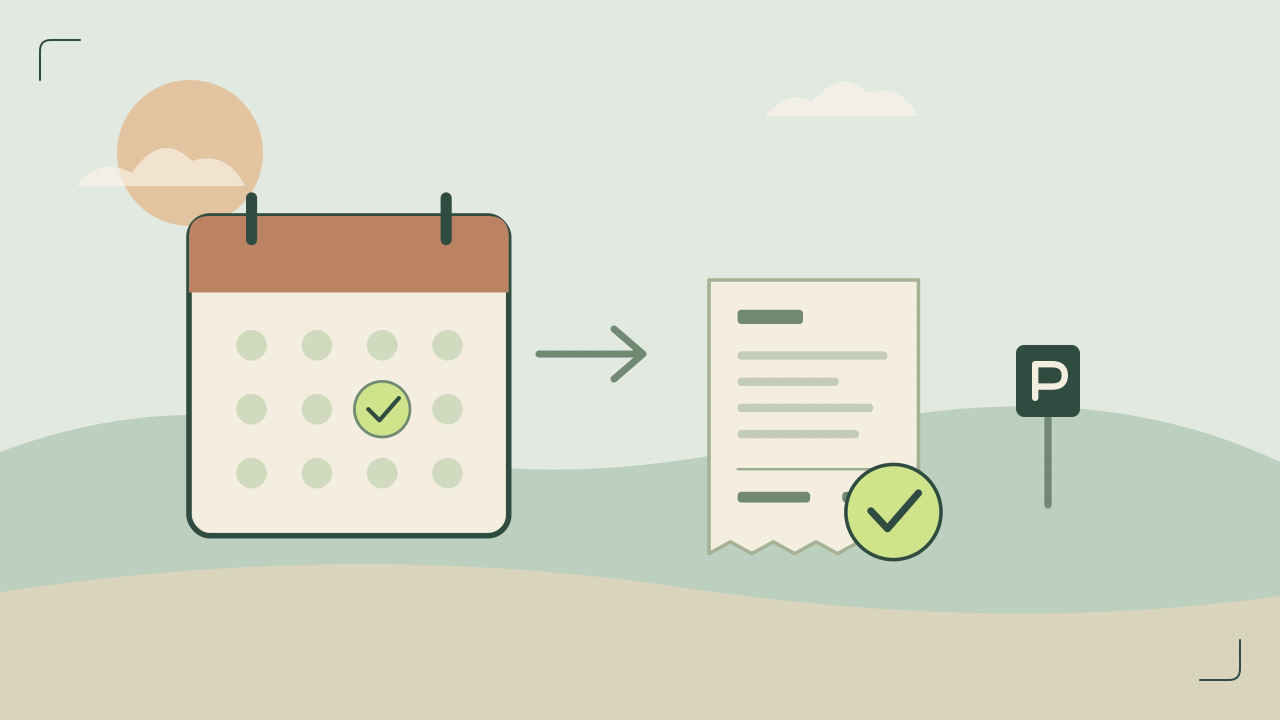
What this guide is about
When people say they have “parking sorted”, they may mean very different things. A plan can mean a booking, a reservation, a route, a reminder, or a pay-by-phone session. A permit is something more specific: it is authorisation to park in a place or under conditions that would otherwise not allow it. In UK parking, that distinction matters because the sign, the bay type, the time window, and the exact user class decide whether you are parked lawfully. A reservation or payment receipt alone does not prove that you are allowed to stay in a bay. The official rules are set by the signage and road markings, not by optimism or a confirmation email. (gov.uk)
This guide explains that difference in plain English, with practical examples for city streets, shared-use bays, controlled parking zones, visitor parking, and accessible travel. It is written for readers who want to avoid the common trap of assuming that “I paid” equals “I can park anywhere”. It does not replace the signs on the day, and it is not legal advice. (gov.uk)
The short version
A parking plan is a method
A plan is how you intend to park: pre-booking a car park space, setting aside time to load passengers, using a pay-and-display machine, or arranging a visitor permit in advance. It is administrative. It may help you park, but it does not automatically grant the right to park in a specific bay. (gov.uk)
A parking permit is permission
A permit is a controlled right to park, usually tied to a zone, user class, vehicle, or time period. Councils describe permit bays as places where a permit must be displayed or a virtual permit session must be active during controlled hours. Some permits are resident-only, some are business or visitor permits, and some are special badges for disabled users. (gov.uk)
The sign wins
If the bay sign says “Permit Holders Only”, a pay-and-display ticket or a booking confirmation is not enough unless the sign also allows that use. If the sign says shared use, you may be able to park either with a permit or by paying. If the zone is outside controlled hours, the rules may change again. Always read the sign at the bay and any zone entry sign. (gov.uk)
Why the difference matters
Planning is not parking rights
Many drivers think parking is just a question of finding a space and paying for it. In reality, parking is often a layered system. There may be:
- a zone boundary sign,
- an upright bay sign,
- a pay machine or app,
- a permit requirement,
- a maximum stay,
- and separate loading or disabled-badge rules. (gov.uk)
That means a perfectly reasonable plan can still fail if it does not match the restriction on the street. For example, a driver may reserve an off-street space for an evening event but arrive early and stop briefly in a nearby resident bay. If that bay requires a permit at that time, the reservation elsewhere does nothing to help. The same applies if a visitor buys a parking session in a paid bay but then drifts into a permit-only bay because it is nearer the entrance. The booking is not a substitute for the bay sign. (gov.uk)
Permits are often zone-specific
Councils often limit permits to specific controlled parking zones, permit classes, or bay types. Camden’s traffic orders show that permit-holder, paid-for, and shared-use controls can be organised by zone and bay type, but you should always check the current permit page and traffic order for the exact street before you rely on any permit. A permit may be valid in one place and useless a street away. (camden.gov.uk)
What a plan can be
1) A pre-booked car park space
A pre-booked space is a parking plan, not a universal permit. It can be useful when you know your destination, want certainty, or need step-free access close to an entrance. But you still need to check the operator’s rules for arrival, stay duration, vehicle height, access hours, and whether the booking is for a named bay, a general car park, or a particular event period. If the operator’s rules and the on-site signs conflict, the on-site signs and the operator’s current terms are what you should follow. (gov.uk)
2) A pay-by-phone session
Pay-by-phone is also a plan. It records payment or authorisation for a parking session, but it does not override the bay type. The space still has to be one where that payment method is allowed. GOV.UK’s sign guidance shows that some bays are pay-and-display, some are permit-holder only, and some are shared use. A session bought for one kind of bay does not make another kind of bay lawful. (gov.uk)
3) A visitor arrangement
If you are visiting someone, the plan may be that the resident issues a visitor permit or voucher. That can work, but only in the specific circumstances the council allows. Visitor permits are council-specific and may vary by zone, vehicle type, duration, display method, and whether they are virtual or physical. A visitor arrangement is therefore conditional, not generic. (camden.gov.uk)
What a permit is
A permit is a rule-based authorisation
A permit is an entitlement to park under conditions that are otherwise restricted. It might be physical, virtual, resident, business, visitor, trade, or disability-related. It may be tied to a zone code, a vehicle registration, a bay type, a household, or a class of user. The important point is that the permit is not just “permission in principle”; it is permission defined by the place, the signs, and the conditions. (gov.uk)
Virtual permits count too
Some councils use virtual permits, so there may be nothing physical to display. Where that system is used, the permit still depends on the correct vehicle registration, zone, date, and active record. The absence of a paper disc does not mean there is no permit; it means you must check the council’s current digital permit instructions carefully. (camden.gov.uk)
Disabled badges are not a blank cheque
A Blue Badge or similar disabled parking badge can expand where you may park, but it does not create unlimited rights. The British Museum says its accessible spaces must be booked in advance, and Camden says a Blue Badge holder can park in certain spaces only if the badge is displayed correctly and the location permits it. Disabled parking is still rule-based parking. (britishmuseum.org)
Reading the signs like a local
Permit holders only
If a bay says “Permit Holders Only”, the ordinary meaning is simple: a valid permit is required during the times shown. GOV.UK’s traffic sign guidance states that permit-only bays may be signed with times, or may operate at all times, and that some residential streets may have few or no markings beyond an entrance sign. Do not assume the lack of paint means the restriction is weaker. (gov.uk)
Shared use
Shared-use bays are the flexible middle ground. They may allow permit holders and pay-and-display users, or permit holders and limited waiting, depending on the sign. Brighton & Hove’s guidance says permit bay signs show the zone and times, while paid parking or shared-use bays may be used if you have the relevant payment or permit. Shared-use is useful, but only if you read the exact condition attached to that sign. (brighton-hove.gov.uk)
Controlled parking zones
In a controlled parking zone, the zone entry sign tells you the general rules for the area, but the upright bay sign still matters. GOV.UK explains that different parking places within a CPZ may have different times and user groups, and the bay sign may differ from the zone entry sign. Sutton’s guidance says you will know you are entering a CPZ by the large signs at the entry points, and that residents, permit holders, and pay-and-display users can all be treated differently within the same zone. (gov.uk)
Outside controlled hours
Many streets switch rules by time. A bay that needs payment or a permit during the day may be free outside controlled hours. GOV.UK’s guidance says that where parking-place controls do not operate at all times, any vehicle may park in the bay without payment or time limit unless other restrictions are indicated. That is helpful, but it only helps if you are sure the time on the sign has actually passed and there are no extra restrictions. (gov.uk)
Common misunderstandings that cause tickets
“I booked it, so I can use any nearby bay”
No. A booking is usually for a defined car park or space. It does not create rights in nearby resident bays, loading bays, yellow-line areas, or permit-only streets. If the booking does not match the bay, the booking is irrelevant to enforcement. (gov.uk)
“I paid by phone, so the permit rule no longer applies”
No. Payment and permit are different tools. Some signs allow one or the other; some allow both. Where a bay is permit-holders only, payment alone does not change the restriction unless the sign says otherwise. (gov.uk)
“The space looks empty, so it must be fine”
Also no. An empty bay can still be restricted. A permit bay, Blue Badge bay, loading bay, suspended bay, or resident-only bay may all be empty and still enforceable. (gov.uk)
“There were no signs on my street”
Some permit-only streets may have few or no repeat signs within them, especially in cul-de-sacs, because the entry sign is doing the main work. Do not rely on the absence of nearby signs without checking the street entry and any repeater plates. (gov.uk)
Practical examples
Example 1: A theatre visit in central London
You pre-book a car park near the venue. That is your plan. But when you arrive, the only street space is marked “Permit Holders Only” during the event window. Unless your booking is for that exact street or bay, you cannot use it. The right move is to use the booked car park or another lawful public bay that matches the sign. In London, councils also warn that controlled hours apply to both the street and the bay itself, so the zone sign and the bay sign should both be checked. (gov.uk)
Example 2: Visiting family in a residential CPZ
Your host may have a visitor permit or voucher. That can make parking lawful in the relevant visitor or shared-use space, but only for the correct zone and duration. Some councils allow visitor permits to be used only for a limited stay, and some require the permit to be displayed or activated exactly as instructed. If you move the car to a different street without checking the sign, the permit may no longer apply. (camden.gov.uk)
Example 3: A museum with accessible parking
The British Museum says accessible parking for Blue Badge holders exists, but the spaces must be booked in advance. That is a useful illustration of the difference between plan and permit: the booking arranges the space, while the badge and the site’s access rules govern whether you can use it. If you arrive without the advance arrangement, the badge alone may not be enough. (britishmuseum.org)
Example 4: Shared-use shopping street
A city-centre bay may say “Permit holders or pay by phone” or “Permit holders or pay and display”. In that case, both routes may be valid. But the time limit could still apply, and the permit may only be valid for a specific zone. The safest interpretation is: choose one of the permitted methods, confirm the zone, and check the maximum stay. (brighton-hove.gov.uk)
How to decide whether you have a plan or a permit
Ask these questions
- Have I only booked or paid, or do I actually hold permission for this bay?
- Does the sign mention my user class: resident, visitor, business, Blue Badge, permit holder, or shared use?
- Is the permission zone-specific?
- Does the time on the sign cover my arrival and departure?
- Is the bay suspended, loading-only, or part of a CPZ with different controls? (gov.uk)
A useful rule of thumb
If your evidence is only a receipt, confirmation email, or screenshot, you probably have a plan. If your evidence shows that the relevant authority has authorised parking in that exact place under those exact conditions, you probably have a permit or equivalent authorisation. When in doubt, assume the sign controls. (gov.uk)
Accessible travel considerations
Blue Badge users still need to check the bay
Disabled badge access is often broader than ordinary parking, but it is not universal. Camden says Blue Badge holders may park in certain bays, and the badge must be displayed correctly. The British Museum says its accessible spaces need advance booking. That combination shows why accessibility planning has two layers: the accessibility plan and the parking entitlement are not always the same thing. (contact.camden.gov.uk)
Step-free access does not guarantee nearby parking
A venue may have step-free entrances, wheelchair access, or accessible facilities without having general public parking. Group visitors to the British Museum are directed to the Montague Place entrance, where coach parking is nearby, but the Museum also says it does not provide parking facilities unless you have a disability. Accessible travel should therefore be planned as a whole journey, not as a parking-only problem. (britishmuseum.org)
If mobility matters, pre-check the exact access route
Look for the nearest lawful bay, the distance to the entrance, whether the surface is level, whether the bay is time-limited, and whether you need to book. For busy central sites, it is often smarter to plan a drop-off plus a booked accessible bay or a nearby public car park than to gamble on a street space. (britishmuseum.org)
A sensible traveller’s checklist
Before you leave
- Check whether you have a booking, a permit, or both.
- Check whether the permit is physical, virtual, resident, visitor, or Blue Badge-related.
- Confirm the zone, vehicle registration, date, and time window.
- Read the official site’s current parking and access page, not an old printout. (westminster.gov.uk)
When you arrive
- Read the entrance sign if you are in a CPZ.
- Read the upright bay sign where you plan to park.
- Check for suspension notices, loading restrictions, yellow lines, or pay-machine instructions.
- Do not assume an empty space is legal. (gov.uk)
If something looks wrong
- Move on and check another bay.
- Use the official website or the on-street signage to confirm the rule.
- If you are visiting a venue, ask the venue’s own information desk or access team rather than relying on general map data. (britishmuseum.org)
What to do if you get it wrong
Do not guess your defence on the spot
If you receive a penalty charge notice, the first job is to preserve evidence: photographs of the sign, bay markings, zone entry sign, ticket, app record, and the vehicle position. GOV.UK’s guidance makes clear that parking enforcement depends on lawful signage and clear restrictions, so contemporaneous photos matter. But this is not a substitute for proper appeal advice or legal advice. (gov.uk)
Focus on the exact restriction
Was the issue that you had only a plan, when a permit was needed? Or did you have a permit but in the wrong zone, at the wrong time, or without the required display or virtual session? Councils often distinguish those situations in their own contravention guidance. The answer can change the way you appeal. (gov.uk)
A simple way to remember the difference
Plan = intention
A plan is what you intended to do: book, pay, visit, arrive, unload, or arrange. (gov.uk)
Permit = authority
A permit is what authorises you to do it in that specific place, at that specific time, under those specific conditions. (gov.uk)
The safest phrase to keep in mind
A reservation tells you where you hope to park. A permit tells you where you are allowed to park. That distinction is the difference between a smooth visit and an avoidable penalty. (gov.uk)
FAQs
Is a pay-by-phone session the same as a parking permit?
No. A pay-by-phone session is a method of paying or authorising a stay. A permit is a specific authority to park in a defined place or under defined conditions. Some bays allow either one, but many do not. Always read the sign. (gov.uk)
If I have a booking confirmation, can I use any nearby space?
No. A booking confirmation only helps if it matches the space or car park you are actually using. Nearby resident bays, permit bays, loading bays, or suspended spaces remain governed by their own signs. (gov.uk)
Do virtual permits work even though there is nothing to display?
Yes, where the council uses them. Westminster says it issues virtual resident permits for new applications and renewals. The vehicle registration must still be correct, and you should check the council’s current instructions for the permit you need. (westminster.gov.uk)
Can a Blue Badge let me park anywhere?
No. A Blue Badge can widen parking options, but it does not override every restriction. Councils and venues still require the correct bay, display, and booking conditions where applicable. (contact.camden.gov.uk)
What should I trust if the website and the street sign seem different?
Trust the on-street restriction first, then the operator or council’s current official guidance. If there is any doubt, use another bay or contact the authority before leaving the vehicle. Signs at the location are the immediate control, and councils emphasise that restrictions must be read where you park. (gov.uk)
Are parking rules identical throughout the UK, especially concerning Blue Badge holders?
No. The broad principles are similar, but the exact rules depend on the local authority, the parking zone, the sign in front of you, and—where disability parking is involved—the part of the UK you are in. GOV.UK says Blue Badge information on its main parking-finder page is for England and Wales only, and it directs readers to the separate rules for Scotland and Northern Ireland. That is why you should check the official source for the place you are visiting rather than relying on memory or assumptions. (gov.uk)
Final takeaway
If you remember only one thing, remember this: a parking plan is useful, but a permit is what makes parking lawful where control applies. The sign, the zone, the time, and the bay type are the real decision-makers. When planning a trip, especially to a busy city centre or an accessible venue, make the parking method match the bay rather than hoping the bay will match the method. That is the simplest way to avoid fines, confusion, and last-minute stress. (gov.uk)
If you are planning a city trip, you may also find our destination guides useful: London, Manchester, Birmingham, Liverpool, Leeds, Glasgow, Edinburgh, Bristol, Oxford, Cambridge, and Brighton.